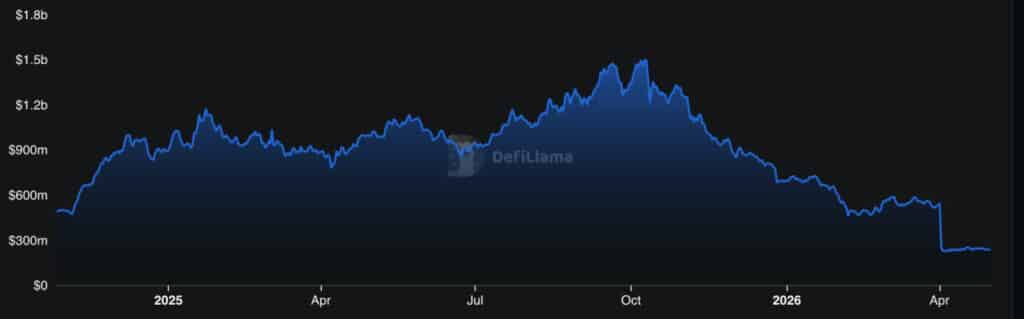
Aave v4, the newest iteration of DeFi’s dominant lending protocol, has crossed $50 million in deposits on Ethereum. That figure represents a clean 100% increase from roughly $25 million just a month earlier, according to DeFiLlama data.
How Aave v4 got here
The Aave DAO overwhelmingly approved the activation of v4 on May 4, 2026. The governance vote wasn’t just a rubber stamp. It came with a deliberate framework: launch conservatively first, then gradually loosen the parameters over time.
That means credit lines and asset onboarding are still relatively restricted compared to what v4 will eventually support.
The conservative approach wasn’t born from excessive caution for its own sake. It was a direct response to real events. Back in March 2026, the DeFi ecosystem was rattled by a slippage incident that resulted in approximately $50 million in losses during a swap. MEV bots extracted significant profits during that event, which put a spotlight on the persistent liquidity risks lurking in decentralized finance.
That incident cast a long shadow. It forced Aave’s governance community to think carefully about how v4 should be introduced. The answer was: slowly, with guardrails, and with a follow-up vote planned to finalize broader parameters once the system proved itself stable.
By May 9, 2026, deposits had already blown past $50 million.
Why the growth matters
Look, $50 million in total deposits is not going to make anyone mistake Aave v4 for Aave v3, which commands billions in TVL across multiple chains. But context matters here.
This version is barely a week old in its activated state. The parameters are intentionally restrictive. And yet deposits doubled in a month, growing from $25 million to over $50 million on Ethereum alone.
What this means for investors
The planned follow-up vote to finalize v4’s broader parameters is the next catalyst to watch. If the DAO votes to expand credit lines and onboard additional assets, that could unlock a second wave of deposit growth.
There’s also a competitive dimension worth considering. Aave has long been the dominant lending protocol in DeFi, but challengers like Morpho, Spark, and Fluid have been chipping away at market share with modular architectures and different risk frameworks.
The March 2026 slippage incident still looms in the background. It demonstrated that even well-established DeFi protocols face liquidity risks that can materialize suddenly and expensively. The conservative launch strategy reduces the risk of a catastrophic early failure, but it also means v4’s true potential, and its true vulnerabilities, won’t be fully visible until the training wheels come off.